
Dungeon master storytelling with a cinematic flair
Creative Dungeons & Dragons storyteller Nigel shares some of his inspiration in crafting a campaign that hits all the feels
I’m fascinated by the concept of Dungeons & Dragons as a vehicle for storytelling, more so than rolling dice and casting spells. That’s fun too. I’m talking about sitting at a table as someone rolls out a grand story that carries the players into another world and on to an epic adventure.
The only D&D experiences I’ve had are all connected with one thoughtfully creative dungeon master: Nigel.
Nigel of the same Nigel who Mario Karted the real life rainbow road in Tokyo dressed as Wario.

He’s created some fantastic stories with intense details, twists and turns and such. At one point he pulled out a guitar and performed a song as one of the characters in a multidimensional pub.
I wanted to dig into what makes a good dungeon master and what makes a good D&D campaign, so I asked Nigel.

How do you get started building a new campaign? What comes first for you?
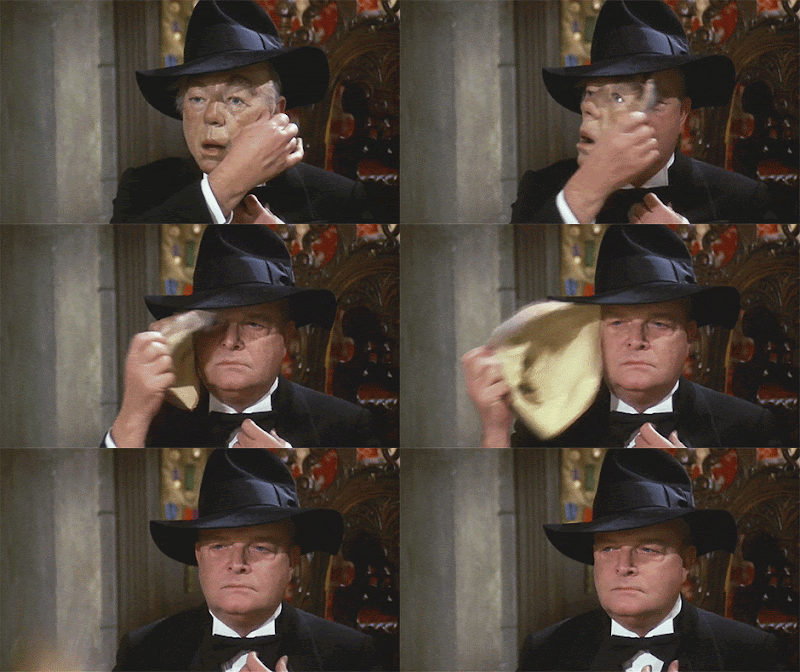
They say creativity is knowing how to hide your sources. My ideas for campaigns come from movies or TV I love. Murder By Death, Heavyweights, Murder on the Orient Express, Prison Break. I have developed or am in the process of developing campaigns based on all of these.
When something captures my attention and my emotion, I can't help thinking what would I do if I was in that situation. D&D provides a framework for me and my players to answer that question.
For me to build a campaign around it, it has to be emotionally compelling, offer the opportunity for creative problem solving and an opportunity for some silliness.
How do you bring this fictional world alive for the players?
A map is always a good start, it helps anchor places and set the scene with a landscape and expectations about who they'll meet there. A port town will naturally have bars and warehouses near the docks. Residents will be more welcoming of outsiders because they're more likely to meet them, compared to a remote town in the mountains where outsiders might be looked on with more suspicion.
Large cities are more likely to have a diversity of merchants where a small village might only have a blacksmith. I think context about the players’ surroundings is the first step in bringing the world to life.
The second step is shaping the non-player characters (NPC). Nobody is ever one-dimensional, so I try to make my NPCs multidimensional (sometimes literally):
A potato farmer that just wants to dance
A divorcee training to become a fighter to impress his ex and kids
A bartender in hell that has dreams of being a baker
I feel like the more multifaceted I can make my NPCs, the closer it is to real life.
D&D can be a direct line or an open-ended world. How much of your story is planned and how much do you leave open for improvisation?
In the beginning I tried to plan for all contingencies and that is just impossible. You never know what your players are going to do. You can lay out a plot hook but there is no guarantee they'll take it, and if you force them to take it, it takes agency away from the players and dampens the emotional connection to the story they're telling.
Now I try to only plan the major plot points, any big twists and reveals, but I leave them free-floating so they can be slotted in when it best suits the story and when it will make the players feel like it was earned. I try to present a vague goal, let the players collaborate on a plan and then I add natural obstacles along the way.
How do you determine characters to place in your story and how the players might interact with them?
L typically put together three or four characters that are important to the story. The big bad, of course; one or two of their lieutenants to provide expectations of the big bad's power, temperament and some exposition if needed; and the informant, somebody they can trust for information and context of the story.
I’ll let the story setting and time period dictate the soft boundaries of the story and any other additional characters. I have lists of merchants with everything they might provide and what it would cost.
With a good map I can set up a specific location. I can improv many of the NPCs to fill the locations. That's where a lot of the fun of being a DM comes.
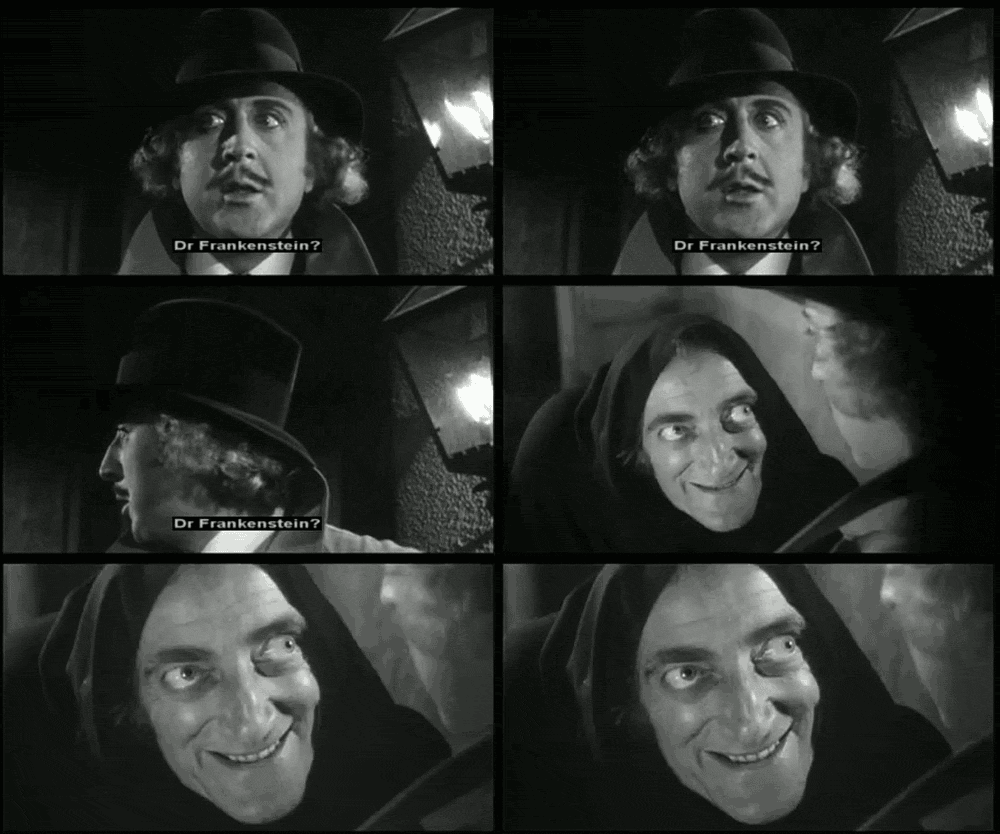
I'll pull from movies, of course. If I need a crime boss, it's Danny Ocean and his crew. If I need an unscrupulous coach driver, it's going to be Marty Feldman from Young Frankenstein.
The more I can leave space for improv, the better the chance the story becomes a collaboration between myself and the players.
Are there any specific ideas or tropes you consistently drop in your campaigns?
I have a NPC that I put in every campaign. An interdimensional traveling salesman by the name of Millie Bays. I put him in because I wanted a way to give my players magical items.
That's something I always love getting in a campaign and wanted a way to provide the items to my characters, regardless of sitting. It provides so many opportunities for creative problem solving and silliness.
The thing about Millie Bays is that he never takes payment in the form of money. He takes payment in the form of emotions or sometimes senses or even body parts. I require that my players improv something from the characters past a cherished or painful memory that will be pulled out of them and perhaps change something about their character's outlook or temperament. They can give up a sense like the smell of cheese or the ability to see the color red. Sometimes they give up pieces of their characters like the dog teeth of half orcs or the pointy ears of elves.
I try to take things from the players I hope they will use in their improv, to add some more depth to their role play. Some players see the opportunity, some don't, but either way it affects the story in a fun way.
Millie Bays keeps showing up with his purple wagon and orange gnomes with green hair. He has a sales pitch at the ready and an interesting price to impose.
If you had to put your campaigns into a genre, how might you describe them?
Each DM will have their own genre, sometimes cross genres. I'd like to think the genre of my campaigns is mostly dramedy, much like my favorite stories. I want to have that emotional impact with a good dose of silliness.
I often tend towards horror as well. The wild swings from horror to comedy give more impact to both. If I can put a shiver down the spines of my players before relieving it with a joke, I find it makes the experience a lot more memorable.
I once had a group of ghouls that came out of the sewer, abducted a person and as the players watched, they started to consume the victim alive. When the players attacked, the ghouls had thick Italian accents and were seasoning the victim with garlic, rosemary and thyme paired with a nice Chianti.
I called them gaba-ghouls and they were one of the most memorable parts of the campaign.

So much of the experience is in how the players respond, how do you stay flexible but also keep them on track toward the “goal?”
I like to use time, an event they know is going to happen in so many days or hours that they need to attend. The natural consequences being missing information or items. They'll then need to gather the items in another way.
How I build the setting helps too: mountain passages blocked by rubble, thick forests full of monsters. The key being obstacles they can overcome but will cost resources if they choose to take that path. If they go too far afield, perhaps having a beloved NPC abducted by the big bad giving them the opportunity to go back and save them.
I try to make the goal as enticing as I can while still leaving it their choice whether or not to pursue it. Sometimes that means being open to throwing the campaign away and building something new.
What’s a moment from a campaign you were the dungeon master for that completely surprised and delighted you and the players?
The campaign was loosely based on the ‘90s comedy Heavyweights. The players were prisoners in a work camp run by "Tony,” the sadistic camp owner. I had set up a clique of cool prisoners. They all wore leather jackets and ate at the best table in the lunchroom, and they were picking on the player characters.
Everyone in the prison camp had to wear power restraining collars so they couldn't use any damage dealing spells. One of my players decided to take over the cool kids club and the way they did it was by using a very innocuous spell called prestidigitation.
The spell deals no damage. But you can:
Clean or soil an object one-foot in size
Light or snuff out a candle
Create a harmless shower of sparks or light
All perfectly legal by the rules that laid out in the campaign. What I didn't expect them to do was pick a fist fight with the leader of the cool convicts and then use the spell to soil the leader's pants to make it look like he pooped himself.
I was shocked. Everybody was laughing, so I rolled with it. The cool convicts immediately lost all respect for their leader and elected the player leader giving the players access to resources. Resources I was originally going to make them work for but now as the leader of this gang they got immediately.
This meant the players skipped about a third of the campaign by making one guy poop himself. It quickly became a running joke that made the campaign way better. I could never have predicted it. It was a stroke of genius and even though it bypassed a lot of the work I'd put in, I wouldn't change it for the world.
What keeps you coming back to D&D?
The opportunity I get to enjoy the company of my friends. This has been a way to stay in touch with people all over the country and to get to know some people better. I've been invited to weddings by people I only know from playing D&D.
The adventures that happened through communal storytelling. Shared experiences that only took place in our collective imagination but created real bonds all the same.
The game helps you glimpse people unfettered, a look behind the curtain people put up during real life interactions and see who they'd like to be or things they hold dear. To watch their creativity and sense of humor come to the forefront.
I think it's one of the best ways to get to know people. I have a long-standing theory that the first character you create in D&D is your idealized version of yourself. And every character after that has a piece of you who you'd like to explore.
Hey! You made it to the end! If you have a unique perspective on storytelling, I’d love to learn more from you and share it with the other readers of Title TBD.